

What Is a Cervicogenic Headache?
A cervicogenic headache (CGH) is a secondary headache — meaning the pain originates not in the brain, but in the cervical spine (neck). Dysfunction in the upper cervical vertebrae, joints, muscles, or nerves refers pain upward into the head, often mimicking a migraine or tension headache.
Cervicogenic headaches are one of the most misdiagnosed and undertreated headache types. Many patients spend years on migraine medications that don't work — because the true cause is structural, not neurological. At Omaha Headache Clinic, we specialize in identifying and correcting the cervical spine dysfunction that drives these headaches.

How the Neck Causes Headaches
The upper cervical spine — particularly C1, C2, and C3 — shares nerve pathways with the trigeminal nerve, which supplies sensation to the head and face. When these vertebrae are misaligned, injured, or degenerated, they irritate these shared nerve pathways and refer pain into the head. This is called the trigeminocervical nucleus — and it is the anatomical reason why neck problems cause head pain.
C1 (Atlas) Misalignment
The atlas sits directly beneath the skull. Even a small misalignment here can compress nerves and restrict blood flow, triggering headaches that radiate from the base of the skull to the forehead.
C2 (Axis) Dysfunction
The C2 nerve root is the most common source of cervicogenic headache pain. Irritation here causes a characteristic pattern of pain that starts at the back of the head and wraps around to the eye or temple.
C3 Joint Degeneration
Arthritis or disc degeneration at C3 can chronically irritate the third occipital nerve, producing a dull, aching headache at the back of the head that worsens with neck movement.
Suboccipital Muscle Tension
The small muscles at the base of the skull tighten in response to cervical misalignment, compressing the greater occipital nerve and producing a deep, boring pain that radiates over the top of the head.

Cervicogenic Headache Symptoms
Cervicogenic headaches have a distinct pattern that sets them apart from migraines and tension headaches — though they are frequently confused with both.
- Headache that starts at the base of the skull or back of the neck
- Pain that radiates from the neck up to the forehead, eye, or temple on one side
- Headache triggered or worsened by neck movement or sustained neck positions
- Reduced range of motion in the neck
- Shoulder, arm, or upper back pain on the same side as the headache
- Headache that worsens after prolonged sitting, driving, or screen time
- Tenderness at specific points along the upper cervical spine
- Nausea or light sensitivity (often mistaken for migraine)
Key diagnostic clue: If your headache is triggered or worsened by turning your head, looking up, or sustained neck positions — it is very likely cervicogenic in origin.
Common Causes of Cervicogenic Headaches in Omaha Patients
Identifying your specific cause is the first step to lasting relief. These are the most common drivers we see in Omaha patients.
Whiplash & Auto Accidents
Whiplash injuries damage the ligaments, discs, and joints of the upper cervical spine. Even minor accidents can leave the neck in a chronically dysfunctional state that generates daily headaches for years.
Forward Head Posture & Tech Neck
Every inch the head shifts forward adds 10–12 lbs of stress to the cervical spine. Years of phone and computer use create the chronic cervical strain that drives cervicogenic headaches.
Cervical Disc Degeneration
Degenerative disc disease in the upper cervical spine reduces disc height, narrows nerve canals, and creates chronic joint irritation — all of which refer pain into the head.
Cervical Arthritis (Spondylosis)
Bone spurs and joint degeneration in the upper cervical spine can directly compress or irritate the nerves that refer pain into the head.
Poor Sleeping Position
Sleeping on your stomach or with too many pillows forces the cervical spine into sustained abnormal positions, straining the joints and muscles that generate cervicogenic headaches.
Prolonged Desk Work & Driving
Sustained static postures — especially with the head tilted forward or to one side — are a primary trigger for cervicogenic headache flare-ups in office workers and long-haul drivers.
Our Treatment Approach
How We Treat Cervicogenic Headaches
Our treatment approach targets the specific cervical structures causing your headaches — not just the pain itself.
- 01
Comprehensive Cervical Evaluation
We perform a detailed structural examination including postural analysis, cervical range of motion testing, orthopedic and neurological testing, and digital X-rays to identify exactly which cervical levels are dysfunctional.
- 02
Precision Cervical Adjustments
Targeted chiropractic adjustments to the dysfunctional cervical segments restore proper joint motion, reduce nerve irritation, and break the pain-referral cycle that causes your headaches.
- 03
Chiropractic Biophysics (CBP) Spinal Correction
For patients with significant cervical curve loss or forward head posture, we use CBP mirror-image adjustments and traction to structurally restore the cervical lordosis — addressing the root cause rather than just the symptoms.
- 04
Soft Tissue & Suboccipital Release
We address the tight suboccipital muscles and fascial restrictions at the base of the skull that compress the occipital nerves and perpetuate cervicogenic headache patterns.
- 05
Corrective Exercises & Postural Rehab
We prescribe specific cervical strengthening and postural correction exercises to stabilize your corrected alignment and prevent recurrence — especially important for desk workers and drivers.
Real Patient Results
Cervical Curve Remodeling — Before, During & After
These X-rays show the structural correction achieved through Chiropractic Biophysics care. Restoring the natural cervical lordosis reduces nerve irritation and eliminates the mechanical source of cervicogenic headaches.
Medications can mask the pain — but medications cannot remodel the spine. Only traction-based Chiropractic Biophysics care can physically restore the cervical curve and remove the structural cause of your headaches.
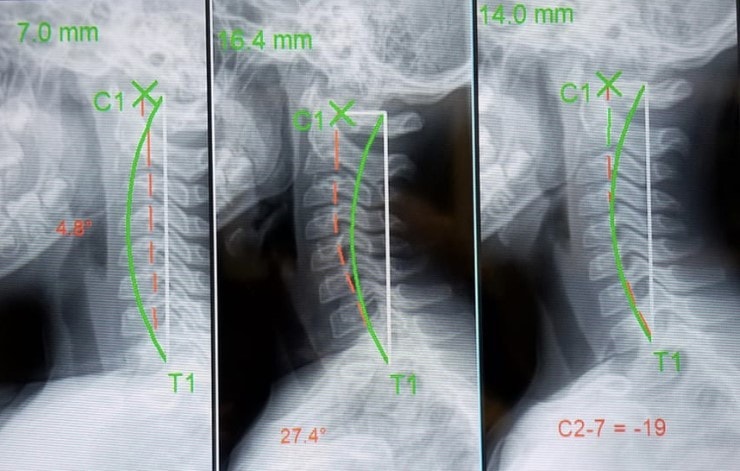
Reduced or reversed cervical curve
Increased mechanical stress on upper cervical joints and nerves — the direct cause of your headaches.
Progressive curve restoration
Precision CBP adjustments and traction gradually remodel the cervical spine toward its ideal alignment.
Natural lordosis restored
Proper curvature reduces nerve irritation, relieves joint stress, and eliminates the structural source of headaches.
Cervicogenic vs. Migraine vs. Tension Headache
Getting the diagnosis right is critical — the wrong treatment won't work. Here's how cervicogenic headaches differ from the two most common headache types they're confused with.
| Feature | Cervicogenic | Migraine | Tension |
|---|---|---|---|
| Origin | Cervical spine (neck) | Neurological / vascular | Muscle tension / stress |
| Pain location | Neck → back of head → one side | One or both sides, throbbing | Band-like, both sides |
| Triggered by neck movement | Yes — hallmark feature | Rarely | Sometimes |
| Nausea / light sensitivity | Mild, if present | Common and severe | Rare |
| Responds to medication | Poorly | Often | Rarely long-term |
| Best treatment | Cervical spine correction | Cervical correction + CBP | Cervical correction + rehab |
We treat all three — and often a combination:
Migraine Treatment Tension Headache Treatment Hunchback Posture Correction Chiropractic BiophysicsFrequently Asked Questions
Common questions from Omaha patients about cervicogenic headaches and chiropractic treatment.
A cervicogenic headache originates in the cervical spine (neck) and refers pain into the head. Unlike a migraine, which is neurological in origin, a cervicogenic headache is caused by structural dysfunction in the upper cervical vertebrae, joints, or muscles. The key distinguishing feature is that neck movement triggers or worsens the headache. Many patients with cervicogenic headaches are misdiagnosed with migraines and treated with medications that don't address the true cause.
Yes. Chiropractic care — especially Chiropractic Biophysics (CBP) — is one of the most effective treatments for cervicogenic headaches. By correcting the cervical misalignments, restoring proper joint motion, and addressing forward head posture, we eliminate the structural cause of the headaches. Most patients see significant improvement within 4–8 weeks of consistent care.
The strongest indicator is whether neck movement triggers or worsens your headache. Other signs include: headache that starts at the base of the skull, pain that radiates from the neck to one side of the head, neck stiffness or reduced range of motion, and headaches that worsen after prolonged sitting or driving. A structural evaluation at Omaha Headache Clinic can confirm the diagnosis with postural X-rays and orthopedic testing.
Many insurance plans cover chiropractic care for cervicogenic headaches. We recommend calling your insurance provider to verify your chiropractic benefits. Our team can also help you understand your coverage options during your initial consultation.
Most patients experience meaningful relief within 4–8 weeks. Full structural correction — especially for patients with significant forward head posture or cervical curve loss — typically takes 3–6 months with Chiropractic Biophysics. The duration depends on how long the condition has been present and the degree of cervical dysfunction.
Yes — whiplash is one of the most common causes of cervicogenic headaches. The rapid flexion-extension of the neck in a collision damages the ligaments, discs, and joints of the upper cervical spine. Even low-speed accidents can cause lasting cervical dysfunction that generates chronic daily headaches. We specialize in post-whiplash cervical correction.
Yes. Our entire approach is drug-free. We correct the structural cervical cause of your headaches through chiropractic adjustments, Chiropractic Biophysics spinal correction, soft tissue therapy, and corrective exercises. No injections, no medication, no surgery.
Stop Treating the Wrong Headache. Get the Right Diagnosis.
If your headaches start in your neck, radiate to one side, or worsen with neck movement — you may have a cervicogenic headache. We can confirm the diagnosis and build a corrective plan. Call us or schedule online.
18460 Wright Street Ste. 9, Omaha, NE 68130